
Hakuba Misorano Guide for Buyers: Estate Rules and Risks
Category: Areas & Neighborhoods
Hakuba Misorano (みそら野) is a villa estate in the Hokujo district of Hakuba Village, developed in three phases from 1965 to 1975 with about 1,300 lots. Its developer, Hakuba Sogo Kaihatsu, runs the Misorano management office, which publishes voluntary estate rules (自主規制) of 20% building coverage and 40% floor-area ratio. Some listings we checked show higher figures.
Below are the estate’s rules, how listings show them, winter and utility arrangements, the December 2023 debris flow, and what to check before you commit.
What is Hakuba Misorano?
Misorano is a privately developed villa estate in Hokujo (大字北城). Hakuba Sogo Kaihatsu (白馬綜合開発株式会社) was founded in 1963 after the village invited the project. It opened phase 1 (160,000 tsubo) in 1965, then sold phase 2 (30,000 tsubo) in 1970 and phase 3 (80,000 tsubo) in 1975. The office describes the estate as “about 300,000 tsubo” with 1,300 lots; the three phases add up to 270,000 tsubo (our arithmetic).
The estate’s guide page names JR Hakuba Station as the nearest station and Hakuba 47 and Happo-One as its ski areas. The management office stands where Misorano Ōdōri meets National Route 148. From the Misorano crossing to the west end is about 3 km, and the area west of the Yazakisuji road is reserved for holiday homes.
The office sold Misorano only as holiday-home land at first. Pension-style guesthouses (ペンション), then restaurants, then permanent homes followed, and it says buyers from abroad, mainly Australia, Europe and the US, have increased. The latest year in its building-count table is 2001:
| Year | Holiday homes | Guesthouses | Houses |
|---|---|---|---|
| 1965 | 0 | 0 | 0 |
| 1970 | 40 | 2 | 0 |
| 1989 | 338 | 82 | 28 |
| 1991 | 362 | 86 | 32 |
| 2001 | 388 | 94 | 100 |
Source: Hakuba Sogo Kaihatsu, “みそら野別荘地の成り立ち” (approximate counts; no later year on the page).
What can you build on a Misorano lot?
Two public pages list the rules: the estate’s own guide (its 自主規制, voluntary rules) and Hakuba Village’s table of agreements in villa subdivisions. They match on most points.
| Rule | Estate guide page | Hakuba Village table |
|---|---|---|
| Building coverage / floor-area ratio | 20% / 40% | 20% / 40% |
| Maximum height | 8.5 m from the front road; 13 m on sites of 500 m² or more | 13 m; 8.5 m on sites up to 500 m² |
| Storeys | not stated | 2 |
| Setback from roads | 10 m from main roads, 5 m from others | 5 m (10 m from main roads) |
| Setback from boundaries | 3 m | 3 m |
Sources: hakuba-misorano.jp/guide/ (no date shown); Hakuba Village “その他基準(規制)等” (updated 22 April 2026).
The two pages word the height boundary differently: “500 m² or more” on the estate page, “up to 500 m²” on the village page. A site of exactly 500 m² falls under both, so ask the office which limit it applies.
The office explains the scale with its own example: a standard lot of about 120 tsubo still allows a two-storey house of 48 tsubo in total floor area. Its guide table gives the basic lot size as “about 130 to 500 tsubo”, so the page itself is not consistent; check the surveyed area of your lot. One tsubo is about 3.3 m² (our conversion).
Other estate rules matter in snow country:
- Submit drawings to the management office while the plan can still be changed.
- If roof snow could fall onto a neighbour or a road, keep enough distance, change the roof shape or fit snow guards.
- Keep enough parking on your own lot, given winter road clearing.
- No fences, stone walls or barbed-wire fencing on boundaries or along roads, so the ploughs can clear the frontage.
- Protect trees, and avoid felling Oyama cherry (オオヤマザクラ) and kobushi magnolia (コブシ) where possible.
The office writes that “in recent years some owners have not kept to” these rules, and in 2018 it asked owners and builders not to fell almost every tree on a lot, and, where red pine and similar trees mean most trees on a lot must be cleared, to plant new trees or a garden after building. When building, it recommends felling red pine and larch that have grown too large, which it says are vulnerable to snow and wind.
Why do Misorano listings show 60% and 200%?
Listings for Misorano lots do not all show the same figures. On 26 November 2026 we read Misorano land listings on a regional portal: some brokers give 20%/40%, others 60%/200%. One broker’s page shows both, as 「60%(自主規制20%)」, with an 18 m height alongside the voluntary 8.5 m.
Hakuba Village’s city-planning area is undesignated for use zones (a non-delineated “white land” area); building coverage and floor-area ratios are set by Nagano Prefecture’s form-control designation. Some listings state 60% and 200% alone, while others show those figures beside the 20% and 40% voluntary rules. Confirm the figures that apply to a given lot on the prefecture’s form-control map and in the important matters explanation; a listing alone does not tell you which limits apply.
Hakuba Village says the details should be confirmed in the important matters explanation (重要事項説明) at the land sale. Its tables also list names that look alike: “太洋みそらの” is a separate row with its own setbacks, and “さくら6区画” (an area guided by a management office) has 40%/80% with no location given. Confirm which agreement covers your lot number.
If a restriction is an officially approved and publicly notified building agreement under the Building Standards Act (including a single-owner agreement, Art. 75 etc.), it binds subsequent land buyers by law and must be covered in the important matters explanation (宅地建物取引業法施行令 Art. 3(1)(ii)). If it is a private estate rule based on management rules or sale-contract covenants, it can still bind a buyer through contract succession or a management agreement. Confirm which legal basis applies to your lot.
Management, snow and utilities
The office’s holiday-home management page describes daily patrols of the estate and a monthly check of building exteriors, reported by postcard or email; confirm what your contract includes. It ploughs estate roads according to snowfall, usually starting before dawn so that roads are passable by about 7:00. Its holiday-home management page describes checks before the snow, including draining water pipes and topping up antifreeze.
Two of its pages differ on parking. Its FAQ says that for holiday homes the office clears the parking space, so you do not need a snow blower.
Its management page offers to clear parking and the approach by the day of your stay if you tell it in advance, as a paid extra; roof snow removal is also a paid extra. Owners of houses and businesses clear snow on their own land. Ask what your contract covers. The management page and its management-content PDF we read show no fee amounts; our Hakuba management fees guide compares what is published.
On sewage, the village’s sewer overview (as of 31 March 2022) says the fourth-phase plan includes Misorano, but that phase was suspended as of that date; ask the village about current plans. The two Misorano land listings we read give public water (with a connection charge), a septic tank (浄化槽) and LPG. Ask for the septic tank’s inspection and cleaning records; see our guide to running costs.
The December 2023 debris flow at Kuromamezawa
On 16 December 2023, a debris flow from the Kuromamezawa stream struck the Misorano district of Hokujo. By the evening of 17 December, the village had checked 55 homes in the affected area: 16 were possibly damaged, including one total collapse and one with flooding under the floor, and the other 14 could not be assessed from outside. The damage and evacuation order applied to a specific zone along the Kuromamezawa stream, not to the entire Misorano estate (about 1,300 lots).
The prefecture’s erosion-control office installed a wire net on 6 March 2024. It trapped sediment when another debris flow occurred on 13 April 2024. The prefecture announced on 31 May 2024 that permanent works would start in June 2024; we did not check later progress.
The village lifted the evacuation order at 17:00 on 6 September 2024 for the area designated on 12 January 2024, with conditions. Anyone staying in the former order area must register with the Misorano office or the village’s General Affairs Division, and evacuate promptly on their own when the Japan Meteorological Agency issues a heavy-rain warning, when the sensor upstream on the Kuromamezawa sounds its warning, or when other warning signs are seen and the mayor judges there is danger.
The village and prefecture pages we read were last updated in 2024, so ask the village about the current works and road restrictions.
We did not check which Misorano lots lie in a sediment-disaster warning area (土砂災害警戒区域). In a land sale, the licensed broker’s important matters explanation must state whether the land lies in a sediment-disaster warning area (宅地建物取引業法施行規則 Art. 16-4-3, item 2), outline restrictions such as development-permit limits if it lies in a special sediment-disaster warning area (宅地建物取引業法 Art. 35(1)(ii) and Enforcement Order Art. 3(1)(xlv)), and give the land’s location on the flood-risk map the village provides under the Flood Control Act where shown (Art. 16-4-3, item 3-2).
What Misorano land prices look like
The estate’s guide page gives a price band of ¥20,000–50,000 per tsubo, with no date. On 26 November 2026, the same office’s listing page showed a Misorano lot (listing No. 7104, total price blank) with a listed unit price of ¥394,000 per tsubo—about eight times the ¥50,000 top of that band (that multiple is our arithmetic). Because the band is undated and far from that example, do not use it as a current benchmark. One listing is not a market average either.
Listing prices are asking prices, not sale prices. For official land-price points in the village, see our Hakuba land prices 2026 guide. The office’s FAQ suggests budgeting roughly 10–20% of the price for purchase costs, as its own rule of thumb.
Checklist before you buy in Misorano
- Get the estate rules and the village’s agreement entry that covers your lot in writing, and compare them with the listing’s figures.
- Check that your planned house meets 20%/40%, the setbacks and the height limit before you agree a price.
- Ask whether the lot sits in a sediment-disaster warning area or a special sediment-disaster warning area, and read the hazard-map item in the important matters explanation.
- Ask the office about the management contract, its fee and what snow clearing it includes.
- Confirm the water connection charge and the septic tank’s condition and records.
- For a used building, check that it is registered; the office’s FAQ notes that many holiday homes and country houses have no ownership preservation registration (所有権保存登記).
For the wider rules on roads, permits and landscape, see our guide to buying land in Hakuba.
Staying in Misorano and buying with us
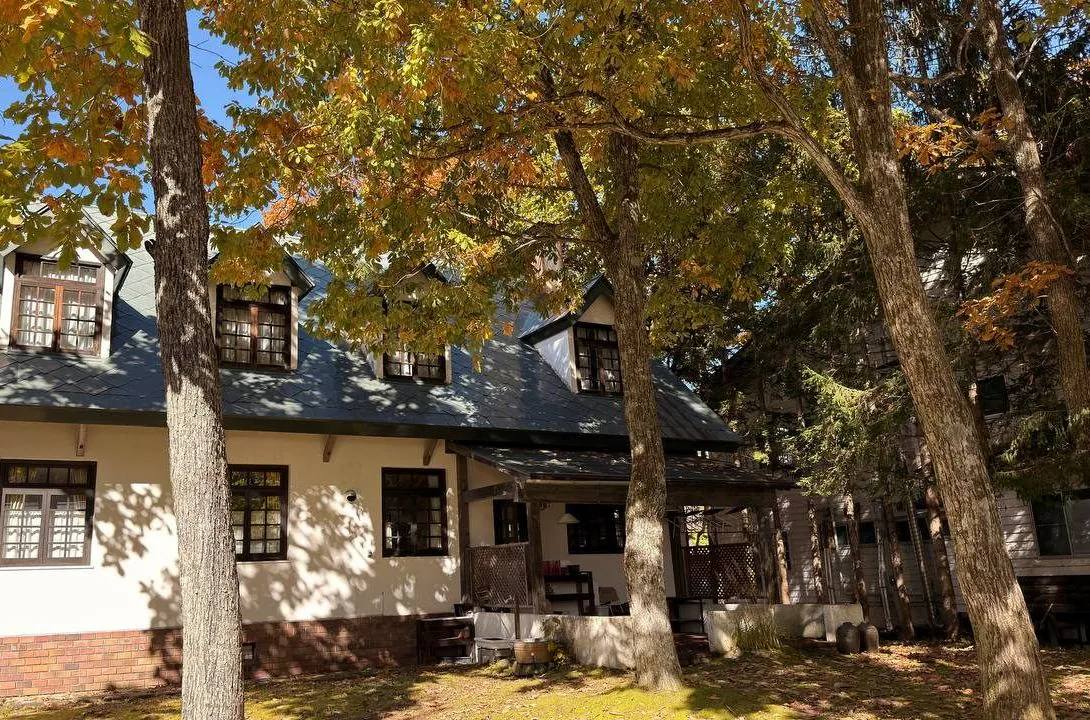
Maykiss, a private chalet owned by Gemini株式会社 (the company that runs this site), is in Misorano: a 5-minute walk, 400 m, to the entrance of the Echoland street, with restaurants, bars and ski rental shops. Its chalet page lists 280 m², four suites and up to 10 guests; the photo above shows it, from the company’s own library.
If you are looking at land or a pre-owned house, our property listings show the transaction type (取引態様) for each one. For a new build, licensed partner builders contract directly with the client and carry out the construction, while Gemini株式会社 handles land-purchase brokerage and assists with liaison and coordination (Gemini株式会社 does not undertake construction contracting).
Hakuba Land is a brand of Gemini株式会社 (宅地建物取引業 大阪府知事(1)第65181号; real estate transactions are handled by our Osaka Head Office).
Sources
- Hakuba Sogo Kaihatsu, Misorano management office: estate guide https://hakuba-misorano.jp/guide/ , history https://hakuba-misorano.jp/history/ , company profile https://hakuba-misorano.jp/aboutus/ , FAQ https://hakuba-misorano.jp/faq/ , management https://hakuba-misorano.jp/management/ , listings https://hakuba-misorano.jp/property/
- Misorano land listings on the regional real-estate portal ココスマ安曇野 (checked 26 November 2026, referenced solely to illustrate how restrictions and utilities are presented; not Hakuba Land listings)
- Hakuba Village, “その他基準(規制)等”: https://www.vill.hakuba.lg.jp/gyosei/soshikikarasagasu/kensetsuka/tochiriyou_kenchiku/kenchikukeikankaihatsu/sonohoka/index.html
- Hakuba Village, sewer overview (as of 31 March 2022): https://www.vill.hakuba.lg.jp/material/files/group/9/siryou1.pdf
- Hakuba Village, Kuromamezawa debris flow notices: https://www.vill.hakuba.lg.jp/gyosei/soshikikarasagasu/somuka/somukakari/11/20231216_saigai_jouhou/10103.html and https://www.vill.hakuba.lg.jp/gyosei/soshikikarasagasu/somuka/somukakari/11/20231216_saigai_jouhou/10109.html
- Nagano Prefecture Himekawa Erosion Control Office: https://www.pref.nagano.lg.jp/himesabo/saigai/kuromamesawa/kokyutaisaku.html and https://www.pref.nagano.lg.jp/himesabo/saigai/kuromamesawa/dosekiryu_hosoku.html
- Ordinance for Enforcement of the Real Estate Brokerage Act, Art. 16-4-3: https://laws.e-gov.go.jp/law/332M50004000012
- Maykiss chalet page: https://maykiss.com/en/chalet
Last checked: 26 November 2026.
Related guides
-
Buying Land in Hakuba: What You Can Build and What to Check
Looking at Hakuba land for sale? Zoning, landscape and development rules, villa-area agreements, road access and what to check before you buy.
-
Buying a House in Hakuba: Yearly Running Costs and Checks
Buying a house or chalet in Hakuba? See the yearly running costs from official tariffs, the winter work an absent owner must arrange, and what to check first.
-
Hakuba Property Management Fees: Covered vs Extras
Hakuba property management fees split into estate dues, empty-home care and rental ops. See what public menus include and which snow lines cost extra.
-
Hakuba House for Sale: How to Read Chalet and Land Listings
Our four Hakuba listings on 25 November 2026 ran from ¥33,950,000 to ¥200,000,000. See how houses are labelled, and what each listing field means.
-
Hakuba Land Prices 2026: Official Data and How to Read It
Hakuba property prices in 2026: official MLIT land price and land survey figures for Hakuba points, what MLIT says drives them, and what to check before buying land.