
Hakuba Onsen Stays: Which Lodgings Use Hot-Spring Water
Category: Skiing, Powder & Lodge Life
For Hakuba onsen stays, our reading of the 225 member cards in the Hakuba Village Tourism Bureau’s lodging directory found that 40 describe the lodging’s own bath as hot-spring water, and 34 of those 40 are in the directory’s Happo area. At a hot-spring lodging, Hakuba Village’s bath tax is ¥150 per person per night, with exemptions such as children under 12 (see below).
The cards were collected on 22 November 2026. Operators write them, none carries a date, and every card says to ask the lodging for details, so use the counts below to make a shortlist, then confirm with the lodging.
Hakuba onsen stays: what the lodging cards say
Hakuba Land read every card that has an 「温泉」 (onsen) row. 75 of the 225 cards have one; 150 do not, and a missing row does not tell you either way. We sorted the 75 rows by what the note says.
| What the card’s onsen row says (our reading) | Cards |
|---|---|
| Names a hot-spring source, calls the bath a natural hot spring, or gives a spring type | 40 |
| Ticks 「有」 (yes) with no detail | 13 |
| Points to public baths nearby; no onsen at the lodging | 14 |
| Artificial or mineral-stone bath, spring water, or 「温泉ではありません」 (not an onsen) | 6 |
| Unclear (bathing hours or a view only) | 2 |
Source: our reading of the Hakuba Village Tourism Bureau member cards, collected 22 November 2026.
By type, the 40 are 21 hotels, 10 ryokan, 5 minshuku, 3 pensions and 1 “other”. None of the 12 cottage cards or the 6 holiday-house (貸別荘) cards is in that group, in our reading. By area, 34 are in Happo, 5 in Iwatake and 1 in the Highland area.
The operator of the Hakuba Happo Onsen day baths also writes that it supplies its water to onsen lodgings in the area (「地域の温泉宿にも給湯しております」). For skiing from that area, see our Happo-One guide.
How to read “onsen” on a Hakuba listing
Japan’s Hot Springs Act (温泉法, Article 2 and its annex) defines an onsen as hot water, mineral water or steam and other gas from the ground (excluding natural gas made mainly of hydrocarbons) that meets the listed temperature or the listed amount of at least one substance: 25°C or more at the source, or, for example, 1,000 mg or more of dissolved substances (excluding gases) per kg.
We grouped six other cards together: their notes describe 人工温泉 (artificial onsen), a mineral-stone bath or spring water, or say 「温泉ではありません」 (not an onsen). This is our grouping of the wording, not a legal test.
Three things on a card tell you more than the yes/no tick:
- The source name: Cards name 白馬八方温泉 (Hakuba Happo Onsen), 白馬姫川温泉 (Himekawa), 白馬塩の道温泉 (Shionomichi) and others. The village’s tourism site lists five onsen by name: Happo, Shionomichi, Himekawa, Katakuri and Mizubasho.
- How the water is used: Of the 40 cards describing hot-spring water, 7 mention only かけ流し (flow-through), 13 a mix of flow-through and 循環 (recirculation), 7 recirculation (one also adds water and heat), and 13 do not say.
- The note, not the tick: One ryokan card in Happo ticks 「無」 (no) and then writes 「源泉:白馬八方温泉」, naming the Happo source (Atarashiya Ryokan in the table below).
Four cards, as written (examples, not a ranking):
| Lodging (card) | Type, area | Onsen note | Private or open-air bath note |
|---|---|---|---|
| Yama-no-Sato Hotel Hakuba Hifumi | Hotel, Happo | Piped from Hakuba Happo Onsen; rooms with an open-air bath use flow-through water from the source | Private family bath free for 60 minutes, booked on the day |
| Hakuba Highland Hotel | Hotel, Highland | Source: Hakuba Himekawa Onsen, 49.9°C, sodium chloride spring | Private bath: 「無」 (no); the open-air bath note says it is known as Tenjin-no-Yu and also used as a day bath |
| Atarashiya Ryokan | Ryokan, Happo | Ticks 「無」, then names the Hakuba Happo Onsen source; flow-through and recirculation | No private-bath or open-air-bath row |
| Restaurant & Hotel Troimerai | Hotel, Happo | Note: two private open-air onsen baths, Hakuba Katakuri Onsen | Two private open-air baths, 7:30–23:00, 50 minutes per room (as written; confirm current terms with the lodging) |
Source: Hakuba Village Tourism Bureau member cards, collected 22 November 2026. Ask each lodging to confirm.
Bathing hours for overnight guests can also be limited. The Hakuba Highland Hotel card, for example, gives 5:00–9:00 and 11:00–24:00. For how hotels, ryokan, pensions and other types differ, see our Hakuba lodging types guide.
Hakuba private onsen: 貸切風呂 and rooms with an open-air bath
A private bath is not necessarily an onsen. If you want a bath for your group only, look for the 「貸切風呂」 (private bath) row. 56 of the 225 cards have one, but only 12 of those 56 are in the 40 hot-spring group, so the row alone does not say whether that bath’s water is onsen; ask the lodging. 25 cards have an 「露天風呂」 (open-air bath) row; 10 of those are in the hot-spring group.
Some cards also give booking terms. Yama-no-Sato Hotel Hakuba Hifumi’s card, for instance, says its private family bath is free for 60 minutes and is booked on the day, and that rooms with an open-air bath use flow-through water from the source.
Hakuba public onsen: winter dates and current notices
Hakuba public onsen (日帰り温泉, day baths) also suit guests at lodgings without hot-spring water. The table shows what the operators’ pages said on 24 November 2026, plus the village tourism page for Tenjin-no-Yu.
| Day bath (spring) | Price (¥) | Hours | Winter 2026–27 status on the page |
|---|---|---|---|
| Happo-no-Yu (Happo Onsen) | Adult 1,000 | 10:00–21:00, last entry 20:30 | Open all year, no closing days |
| Mimizuku-no-Yu (Happo Onsen) | Adult 800 | 10:00–21:00, last entry 20:30 | Open all year, no closing days |
| Kurashita-no-Yu (Shionomichi Onsen) | Adult 800 | Hours page: 10:00–20:00, last entry 19:30; to 20:30 on the day before a holiday | Notice (no year shown): closed 9–27 November for winter preparation and maintenance |
| Sato-no-Yu (Happo Onsen) | Private hire 25,000 per hour for up to 5 people | 13:00–20:30, booking required | Private hire 18 December 2026 – 31 March 2027; bookings open 4 December 2026 |
| Tenjin-no-Yu (Himekawa Onsen, Hakuba Highland Hotel) | Adult 1,000 | 11:00–18:00, last entry 17:00 | Village page; no season given |
Sources: Hakuba Happo Onsen day-bath site; Kurashita-no-Yu site; Hakuba Village tourism site (Tenjin-no-Yu), all read 24 November 2026. Adult fares = junior-high age and over.
The pages do not always agree. The village tourism site lists Happo-no-Yu’s child fare as ¥650 and Sato-no-Yu at ¥800, 16:00–20:00, while the operator lists ¥600 for elementary-school children and the winter private-hire terms above; we show the operator’s figures. Sato-no-Yu’s private hire adds ¥5,000 per person from the sixth guest, includes towels and a drink, and is free for children under 7 (preschool).
Kurashita-no-Yu’s undated notice gives different hours from its hours page: from 24 September it opens at 12:00 (10:00 on weekends and holidays) and closes at 20:00 (20:30 on Saturdays and the day before a holiday), with entry up to 30 minutes before closing. It does not rent or sell bath towels.
Two baths have ended their 2026 season: Obinata-no-Yu (25 April – 31 October) and Iwatake-no-Yu (23 April – 15 November). The village tourism site lists a common bath ticket (温泉共通入浴券): ¥1,200 for ¥1,500 of bathing fees, sold at roadside stations and tourist information offices in the village; it cannot be combined with other discounts, and the page does not list which baths take it.
Hakuba bath tax (入湯税): ¥150 per night
Hakuba Village charges a bath tax on people who bathe at a hot-spring bath (鉱泉浴場): ¥150 per night for overnight guests and ¥50 per day for day bathers, under Article 143 of the village tax ordinance (村税条例). The bath’s operator collects it from bathers.
- Exempt under Article 142 of the village tax ordinance (村税条例): children under 12; people bathing at communal or ordinary public bathhouses (共同浴場・一般公衆浴場) (whether a bath qualifies cannot be judged only by the fact that it is open to the public; ask the operator); bathing at events held for school-education purposes (schools in Japan from elementary through high school; universities and schools abroad are not included); and athletes, officials (役員) and press at international competitions held in Hakuba, as set by the village head.
- The village’s guide defines a taxable bath, in principle (原則として), as a bathing facility using onsen water under the Hot Springs Act; facilities using onsen water brought in from elsewhere are also taxed.
- Bathe at two hot-spring facilities on one day and each one charges it.
- The guide says overnight guests at a hot-spring lodging pay unless there is proof that they did not bathe.
4 of the 225 cards mention the bath tax, and 3 of them say it is charged on top of the listed price. The bath tax is a separate tax from the village’s accommodation tax (宿泊税); see our Hakuba accommodation tax guide.
A whole house with a sauna, onsen in the village
In our reading, none of the 12 cottage cards or 6 holiday-house cards is in the hot-spring group. If your group wants a whole house, ask whether its baths use onsen water, and a public day bath is another option.
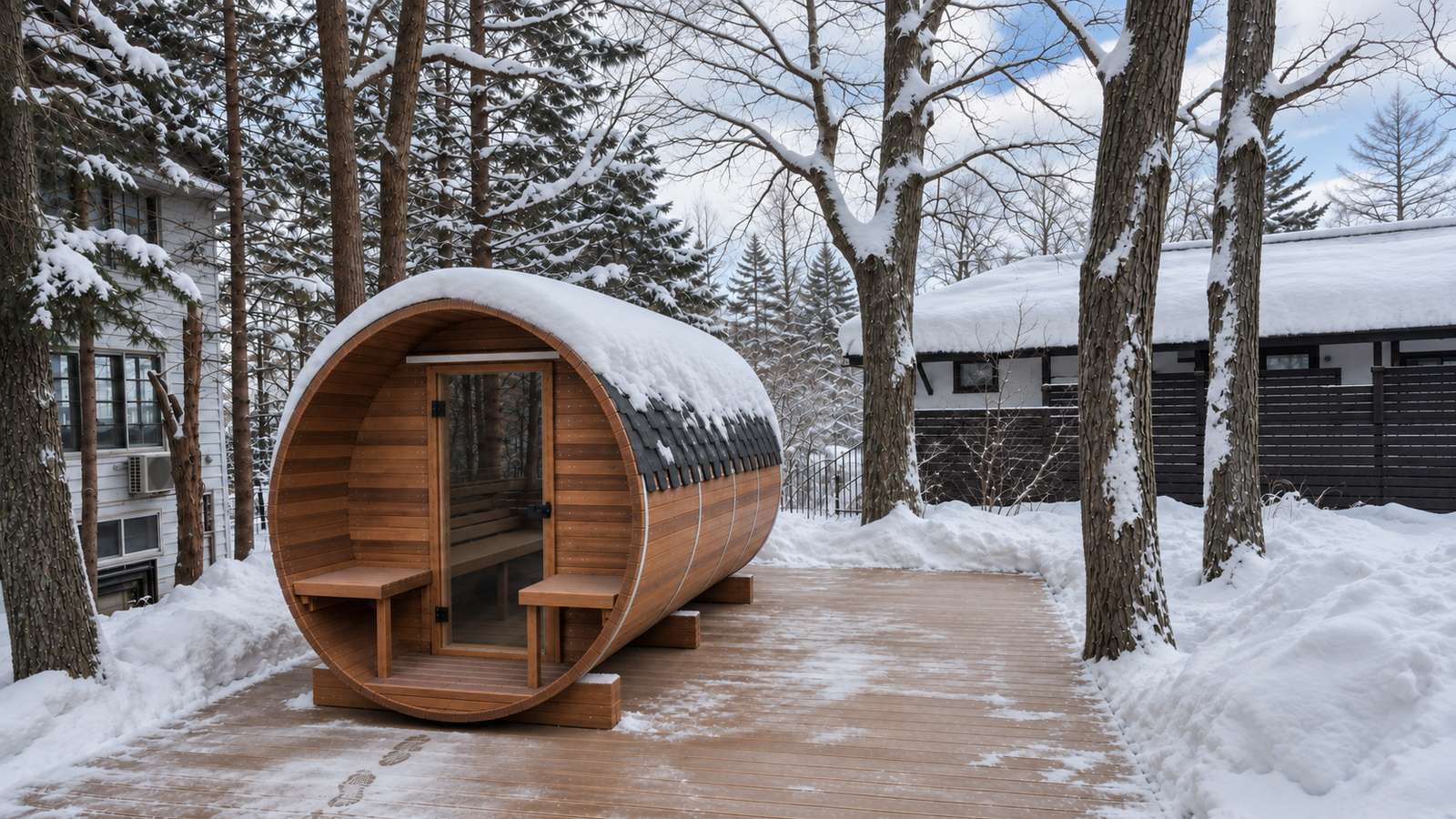
Maykiss is one example. It is a private chalet owned by Gemini株式会社, the company behind Hakuba Land, and the photo at the top shows its sauna, from the company’s own library. Its chalet page lists a wooden sauna hut in the back garden for your group alone and four suites with private bathrooms; it lists no onsen.
Checklist before you book an onsen stay
- Ask which source the bath uses, and whether it is flow-through, recirculated or both.
- Check the bathing hours for overnight guests, and whether the open-air bath is shared, private or in the room.
- For a 貸切風呂, ask the fee, the time limit and when you can book it.
- Ask whether the ¥150 bath tax is inside the quoted price.
- For a day bath, check that week’s notices, and bring a towel to Kurashita-no-Yu.
Sources
- Hakuba Village Tourism Bureau, lodging directory (member cards): https://www.vill.hakuba.nagano.jp/stay/ (cards collected 22 November 2026)
- Hakuba Village tourism site, onsen page: https://www.vill.hakuba.nagano.jp/hotspring/
- Hakuba Happo Onsen day baths: https://hakuba-happo-onsen.jp/dayuse/
- Kurashita-no-Yu: https://kurashitanoyu.com/ (top-page notice) and https://kurashitanoyu.com/hours_price.html
- Hakuba Village, bath tax (入湯税): https://www.vill.hakuba.lg.jp/gyosei/soshikikarasagasu/zeimuka/kazeigakari/2/930.html and the collection guide https://www.vill.hakuba.lg.jp/material/files/group/3/nyuto_tebiki_r7.pdf
- Hot Springs Act (温泉法), Article 2 and annex: https://laws.e-gov.go.jp/law/323AC0000000125
- Maykiss chalet page: https://maykiss.com/en/chalet
Last checked: 24 November 2026.
Related guides
-
Hakuba Pension, Minshuku, Ryokan or Hotel? Lodging Types
Hakuba pension, minshuku, ryokan, hotel, lodge or whole house: what each type means, how many the village directory lists, and the permit to check.
-
Hakuba Accommodation Tax: Rates per Night & Chalet Guide
Hakuba accommodation tax is ¥200–¥1,900 per person per night on room charges of ¥6,000+ before consumption tax. Chalet examples, exemptions and owner rules.
-
Happo-One Ski Resort Guide 2026-27: Runs, Tickets, Parking
Happo-One ski resort for 2026-27: which base to start from, beginner and expert runs, ticket prices incl. the Debut ticket and early-bird deals, parking rules.
-
Hakuba with Kids 2026-27: Childcare, Lessons and Lift Passes
Hakuba with kids, 2026-27: which resorts run childcare and from what age, ski lessons for ages 3–6, kids' lift passes and what to check in a family stay.
-
Hakuba Ski Resort Parking 2026-27: Free Lots and Rules
Parking at Happo-One, Goryu and Iwatake from official pages: free lots, Happo's ¥1,000 gondola lots, overnight parking rules and Nagano's winter tyre rule.