
Hakuba Accommodation Tax: Rates per Night & Chalet Guide
Category: Tax, Law & Visas
Since 1 June 2026, guests staying in Hakuba Village pay an accommodation tax of ¥200 to ¥1,900 per person per night when the room-only rate, before consumption tax, is ¥6,000 or more per person per night. Certain certified stays, such as school trips, are exempt. The amount includes Nagano Prefecture’s ¥100 share. From 1 June 2029 the amounts rise to ¥300–¥2,000 (Hakuba Village).
For a whole chalet, first divide the nightly accommodation charge, excluding consumption tax, by the number of guests charged for accommodation. The examples below show how group size changes the tax. All figures come from Hakuba Village’s ordinance and its official guide for lodging operators.
How much is the Hakuba accommodation tax per night?
The tax is charged per guest, per night, in four brackets. The village collects the prefectural tax together with its own, so you pay one combined amount.
| Room-only rate per person per night (before consumption tax) | 1 Jun 2026 – 31 May 2029 (¥) | From 1 Jun 2029 (¥) |
|---|---|---|
| Under ¥6,000 | 0 (exempt) | 0 (exempt) |
| ¥6,000 to under ¥20,000 | 200 | 300 |
| ¥20,000 to under ¥50,000 | 400 | 500 |
| ¥50,000 to under ¥100,000 | 900 | 1,000 |
| ¥100,000 or more | 1,900 | 2,000 |
Source: Hakuba Village, accommodation tax page (updated 1 October 2026). Until May 2029 each amount includes ¥100 of Nagano prefectural tax; from June 2029, ¥150.
Nights from 1 June 2026 onward are taxed even if they were booked before that date. The night of 31 May to 1 June 2026 is not taxed.
Who collects the tax, and when do you pay?
You pay the tax to the place you stay. Under the “special collection” system, the operator of each hotel, lodge, simple lodging facility or private rental collects it with the room charge and files it with Hakuba Village every month. Registered properties display a certificate from the village where guests can see it, for example at the front desk.
Check whether your quoted total includes it, when payment is due and which payment methods the property accepts. Gemini株式会社’s own chalet Maykiss shows the tax separately on its quotes and collects it at or before check-in. Whatever the method, the village asks properties to show “Accommodation Tax” (宿泊税) and the amount on receipts.
How is the per-person rate calculated?
The bracket depends on the “accommodation charge”: the room-only price per person per night, without consumption tax. The village guide sets out what counts:
- Included: charges for the stay itself that guests are billed regardless of choice, such as cleaning, bedding and bath charges, and related service charges.
- Excluded: meals, drinks and use of facilities other than the room; consumption tax and the onsen bathing tax (入湯税); pass-through costs such as taxis; tips.
- Meal-inclusive rates: if a property only offers rates that include meals, it should separate the meal portion. If it cannot, the whole price counts as the room rate. A “free breakfast” is not deducted.
- Tax-inclusive prices: Japan’s standard consumption tax rate is 10% (National Tax Agency). Where the room charge includes it, divide by 1.1 first. For example, a room at ¥11,000 including tax for two guests is ¥10,000 before tax, or ¥5,000 each, so no accommodation tax is due.
- Discounts and commissions: a discount the property gives itself, such as a member rate, lowers the rate, but a discount paid for with points from a travel agency or card company does not; the pre-discount price counts. A commission the property pays to a booking agent is not deducted.
- Long stays: there is no long-stay exemption; each night is assessed with the same threshold and exemptions. If a multi-night discount is applied to the whole stay, the discounted total is divided by the number of nights.
Whole chalets and villas: divide by the number of guests
For chalets and villas priced per house rather than per person, the village guide divides the nightly room charge by the number of guests to find each person’s rate. A guest with no accommodation charge, such as a child sharing a bed for free, is left out of the count.
Charges not tied to a particular guest, such as an extra-bed charge, are added to the total and shared. Charges clearly tied to one guest, such as a baby-cot charge, are treated as that guest’s own rate.
Example: a chalet at ¥220,000 a night including consumption tax, which is ¥200,000 before tax.
| Guests charged | Rate per person (¥) | Tax per person (¥) | Tax per night (¥) |
|---|---|---|---|
| 2 | 100,000 | 1,900 | 3,800 |
| 4 | 50,000 | 900 | 3,600 |
| 8 | 25,000 | 400 | 3,200 |
| 10 | 20,000 | 400 | 4,000 |
Rates from 1 June 2026 to 31 May 2029; calculation method from the Hakuba Village guide (example 11).
For the four group sizes shown, the total is ¥3,200 to ¥4,000 a night. The total depends on both the number of guests charged and the bracket their per-person rate falls into; with 5 guests, for example, it would be ¥400 × 5 = ¥2,000. Ten adults plus two children staying free of charge pay ¥4,000 a night, or ¥20,000 for five nights.
For hotel rooms the same rule applies per room. A twin room at ¥20,000 before tax is ¥400 for one guest (¥20,000 bracket) and also ¥400 for two (2 × ¥200). With a ¥2,000 baby cot for an infant, the two adults still pay ¥200 each, and the infant’s ¥2,000 is below ¥6,000, so no tax is due for the infant.
Who is exempt?
Age or nationality alone does not make a stay exempt. The exemptions in the ordinance and guide are:
- Pupils and students of a kindergarten, school, university or college of technology (高等専門学校), and those accompanying them, staying for the school’s educational or research activities, certified by the head of the school
- Events run by nurseries and similar childcare facilities, for children aged 3 and over and their leaders, certified by the facility
- Pupils of a free school recognised by a local government, and those accompanying them, at an educational event run by the free school, certified by its head
- Junior high school students, and those accompanying them, in certified community club activities that take over school club activities, certified by the organising body and by the local government or board of education
- Stays by foreign ambassadors and similar officials in the course of their duties, only at a village-approved property and when they present a tax-exemption card
Common calculation and registration mistakes
- Reading the bracket from the price including consumption tax. Divide by 1.1 first; a ¥22,000 tax-inclusive rate is ¥20,000 before tax.
- Counting guests who stay free, such as small children sharing a bed. They are left out of the head count, which raises everyone else’s per-person rate.
- Assuming the guide’s examples use today’s rates. Some worked examples in the village guide show ¥300 and ¥500, the amounts from June 2029. Until May 2029 the amounts are ¥200 and ¥400.
If you own a Hakuba property and rent it out
If you rent out a chalet, villa or condo, as the operator you become the “special collection agent” for that property. The main duties in the ordinance and the village guide:
- Apply to register each property with Hakuba Village no later than 5 days before you start operating (Ordinance Article 10(1)). A property with no stay at all of ¥6,000 or more per person per night files a “specified accommodation facility” notice instead; it does not file returns but must still keep records. The village’s briefing material adds that if you price by the room or by the whole house and that price is ¥6,000 or more, you should apply for registration.
- File a return and pay the tax by the last day of each month for the previous month, even when the amount is zero. If that day is a Saturday, Sunday or public holiday, the deadline moves to the next weekday. The return normally due at the end of December, for November stays, is due on 4 January instead (or the next weekday). You can file online through Graffer or eLTAX, by post or at the village office.
- Keep books and documents showing dates, room charges, guest numbers and tax. Books are kept for 5 years from the day after the end of the month in which the return was filed; documents for 5 years from the day after the end of the month of the stay. Show the tax by name and amount on receipts. If it is not shown clearly, the tax amount may also be treated as subject to consumption tax.
- If you have no address, residence, office or place of business in Hakuba Village, you name a tax administrator (納税管理人) with an address in the village and report it within 10 days, or, if you name someone outside the village, apply within 10 days and obtain approval. This is not needed if the village certifies that collection will not be affected.
If an operator manages the property for you under contract, that operator may be designated as the collection agent instead. A rental that operates without the licence or notification it needs is still taxable. The village says it will work with Nagano Prefecture to survey every lodging facility in Hakuba Village and send inspectors to facilities that have not made the required submissions.
Quarterly filing and payments to operators
A property can apply to file quarterly instead of monthly if its total tax due for stays from December two years before to November one year before the “application year” (the year containing the first day of the fiscal year the special rule is sought for) is ¥3.6 million or less, it started operating before 1 January of the year before the application year and applied for registration before 1 September of that year, and it meets the other conditions in the guide. Newly opened properties must file monthly at first. For quarterly filing from January 2027, the application window is October to 30 November 2026.
For the first five years (1 June 2026 to 31 May 2031), the guide lists reward rates for collection agents of 3.0% where every return and payment was on time, 3.5% where, in addition, every return was filed online, and 2.0% where there was a late payment. The reward is paid only where the calculated amount is ¥500 or more. A separate 2.5% administrative subsidy is also paid. The amounts are calculated by applying these rates to the tax paid by the deadlines (for stays from June of the previous year to May), with the first payment at the end of September 2027.
Breaching the duties to display the certificate, not lend or transfer it and return it, keep books, and prepare and keep documents can be punished under Article 20 with up to one year’s imprisonment or a fine of up to ¥500,000, and a corporation can also be fined (Article 21). Failing without good reason to report a tax administrator carries a non-penal fine of up to ¥100,000 (Article 22).
Confirm your own situation with the Hakuba Village Tax Division (税務課, 0261-85-0712) or a tax accountant.
Renting out a property you own in Hakuba
For buyers who plan to let a chalet, the accommodation tax adds to the work that comes after the licence: registration, monthly returns, receipts and five years of records.
Hakuba Land is a brand of Gemini株式会社, which owns the chalet Maykiss in Hakuba and operates 500 MILES HAKUBA (hakuba500miles.com), a lodging facility licensed under the Inns and Hotels Act (simple lodging, 簡易宿所営業). The same registration rules apply to both. Villa management for other owners is still in preparation.
Related guides: Can foreigners buy property in Hakuba?, Buying land in Hakuba and Hakuba ski resorts compared.
Sources:
- Hakuba Village: Accommodation tax guide page (updated 1 October 2026)
- Hakuba Village: Special Collection Guide, Japanese ver. 1.1.1, 1 October 2026
- Hakuba Village: Special Collection Guide, English ver. 1.0, 1 December 2025
- Hakuba Village: briefing material for lodging operators
- Hakuba Village Accommodation Tax Ordinance (2025 Ordinance No. 2)
- National Tax Agency: Consumption tax rates
Rates and rules were checked against Hakuba Village’s official materials (the ordinance and Special Collection Guide ver. 1.1.1) as of 25 October 2026 and may change. This article is general information, not tax advice. Check the latest rules with the Hakuba Village Tax Division (0261-85-0712) and your own situation with a tax accountant.
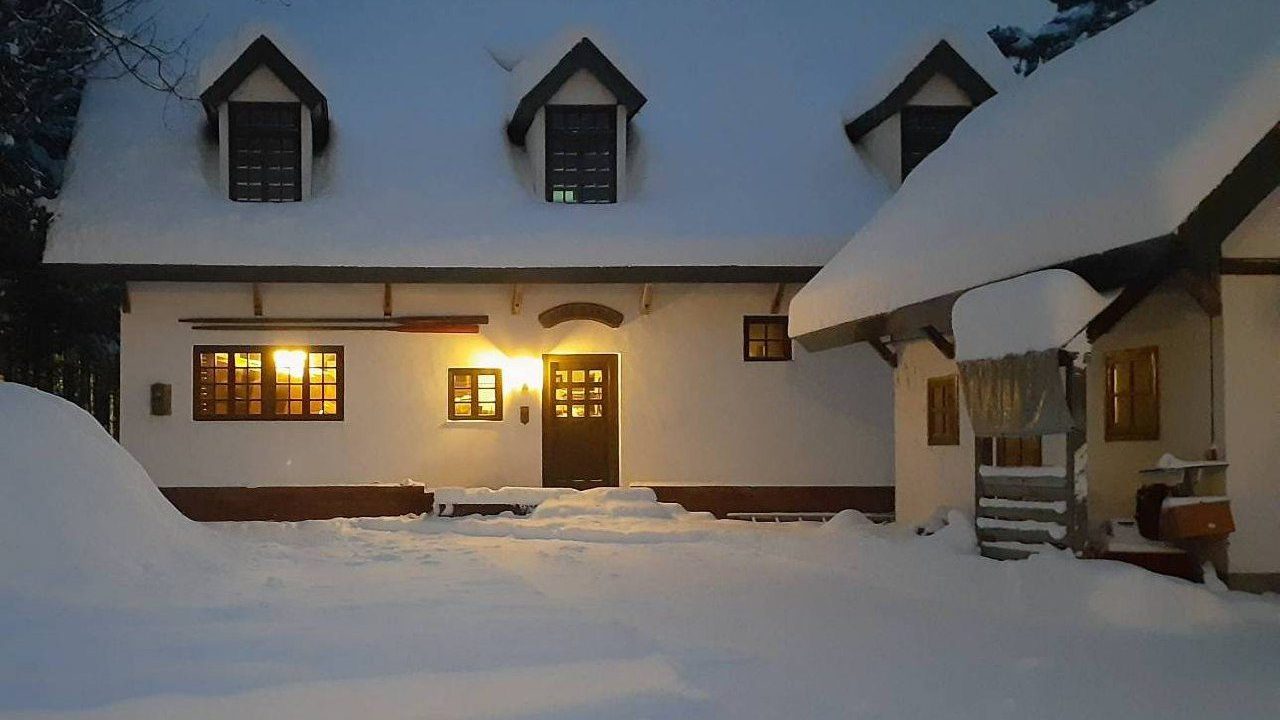
Cover photo: Maykiss, a chalet owned by Gemini株式会社, on a winter evening in Hakuba.
Frequently asked questions
Is the Hakuba accommodation tax included in my booking price?
Ask the property. The tax is set by Hakuba Village and collected by each lodging with the accommodation charge, then paid to the village. Check whether your quoted total includes the accommodation tax, when payment is due and which payment methods the property accepts. The village guide asks lodgings to show 'Accommodation Tax' and the amount on receipts.
How is the tax worked out for a whole chalet?
Divide the nightly room charge, before consumption tax, by the number of guests who are charged for the stay; guests staying free are left out. Each guest's share sets the bracket. For a chalet at ¥200,000 a night before tax with 10 guests, that is ¥20,000 each, so the tax is ¥400 × 10 = ¥4,000 a night (rates for 1 June 2026 to 31 May 2029).
Do children pay the Hakuba accommodation tax?
Children are not exempt because of their age. A child with no accommodation charge, for example one sharing a parent's bed for free, is left out of the head count, and a baby-cot charge is treated as the infant's own rate. Certified school activities, and certified nursery events for children aged 3 and over, are exempt.
Does the tax apply to Airbnb and other private rentals?
Yes. It covers inns, hotels, simple lodging facilities and other lodgings, including private lodging (minpaku), in Hakuba Village. The village guide adds that a rental operating without the licence or notification it legally needs is still taxable.
Related guides
-
Can Foreigners Buy Property in Hakuba? 2026 Buyer Guide
Can foreigners buy property in Hakuba? Yes. Here is the 2026 process, costs, the new non-resident reporting rule, land price data and Hakuba-specific checks.
-
Hakuba Ski Resorts: Hakuba Valley's 10 Resorts Compared (2026-27)
Which Hakuba ski resort suits you? Official data on all 10 Hakuba Valley resorts, picks for beginners, families, powder and park, and the 2026-27 lift pass.
-
Buying Land in Hakuba: What You Can Build and What to Check
Looking at Hakuba land for sale? Zoning, landscape and development rules, villa-area agreements, road access and what to check before you buy.