
Hakuba Pension, Minshuku, Ryokan or Hotel? Lodging Types
Category: Skiing, Powder & Lodge Life
Choose a Hakuba pension for a usually Western-style stay, generally between a minshuku and a hotel; a minshuku for an often family-run, B&B-like lodging in the owner’s home; and a ryokan for rooms that usually have tatami, with rates usually per person including dinner and breakfast. Pensions are the most common type in the village tourism bureau’s member directory: 63 of 223 type-labelled listings on 19 November 2026.
Hakuba Land counted the bureau’s listing cards by type on 19 November 2026 and read Nagano Prefecture’s permit list for Hakuba Village (data as of 30 September 2026). The definitions below come from JNTO, Japan’s national tourism organisation, and from the Ryokan Business Act (旅館業法, Ryokangyō-hō).
Hakuba lodging types: what does each label mean?
The bureau’s lodging directory offers eight type labels: hotel, ryokan, minshuku, pension, lodge, rental holiday house (貸別荘, kashi-bessō), cottage and “other”. The directory itself does not define them, so the meanings in the table come from JNTO where JNTO describes the type.
| Type (directory label) | Listings, 19 Nov 2026 | What the label usually means | Ask before booking |
|---|---|---|---|
| Pension (ペンション) | 63 | Usually Western in style and situated near ski resorts and other holiday areas; generally between a minshuku and a hotel (JNTO) | Private or shared bathroom; dinner or room only; price per person or per room |
| Hotel (ホテル) | 52 | Not defined in the directory; JNTO says Western-style hotels should have amenities such as TVs, heating and internet | Bed type; whether dinner is served on site |
| Ryokan (旅館) | 25 | Rooms usually tatami, with futon laid out by staff; rates usually per person with dinner and breakfast (JNTO) | Per-person price; which meals are included |
| Lodge (ロッヂ) | 25 | Not defined in the directory | Room type, meals and bathrooms on the listing |
| Minshuku (民宿) | 22 | Often family-run, in the owner’s home, similar to a B&B; bathrooms often shared (JNTO) | Shared bathroom; whether you fold your own futon |
| Other (その他) | 18 | Not defined in the directory | Room or whole property; meals; private or shared bathroom |
| Cottage (コテージ) | 12 | Not defined in the directory | Whole building or a room; kitchen; cleaning |
| Rental holiday house (貸別荘) | 6 | Not defined in the directory | Whole building or a room; kitchen; cleaning |
Source: our count of Hakuba Village Tourism Bureau member listings that carry a type label, 19 November 2026 (members only, not every lodging in the village). Meanings: JNTO pages listed under Sources.
If you want tatami, futons and dinner at the inn, start with ryokan. For pensions, lodges and hotels, the label does not tell you the meals or bathrooms, so compare each property’s plans. For a lodge, confirm whether you are booking a private room, a shared room or the whole property. If your group wants a place to itself, check whether a cottage or rental holiday house is let as a whole building.
Hakuba pension or minshuku: what is the difference?
JNTO describes minshuku as often family-run, guesthouse-style lodgings in the owner’s home, similar to a bed-and-breakfast. Rooms often, but not always, have tatami and futons, bathrooms are often shared, and guests usually put away their own bedding. Pensions, in JNTO’s words, are usually Western in style and generally fall between the homey atmosphere of a minshuku and the more upscale amenities of a hotel. They are usually situated near ski resorts and other holiday areas.
The cards also carry area labels. Of the 63 pensions, 29 carry the Happo area label, 17 Iwatake, 15 Goryu and 2 Sanosaka. Of the 22 minshuku, 11 carry the Happo label and 6 Iwatake. Use these labels to shortlist, then check each property’s exact address and transport to the resort you plan to ski; our Hakuba ski resorts guide compares the resorts.
Ryokan and hotels: how do meals and prices differ?
JNTO says ryokan rates are usually charged per person and include dinner and breakfast, although some ryokan offer stays without meals. The bureau’s own search filters prices per adult in two ways, with two meals (1泊2食付) or room only (素泊まり). Before comparing totals, check that the price unit (per person or per room) and the meals included are the same.
Hotels are the second-largest group, with 52 cards, and 44 of them carry the Happo area label. The directory does not say which hotels serve dinner, so check the hotel’s own page if you want to eat in.
What does Hakuba’s licence list show?
Nagano Prefecture’s open data lists 1,308 Ryokan Business Act permit entries in Hakuba Village as of 30 September 2026. The largest municipality after Hakuba in the same file is Karuizawa, with 549. These are entries on an administrative list, not a count of businesses open today. The file does not cover the core cities of Nagano and Matsumoto.
| Permit type on the list | Entries in Hakuba Village |
|---|---|
| Simple lodging (簡易宿所, kan’i shukusho) | 788 |
| Ryokan/hotel (旅館・ホテル) | 265 |
| Ryokan (旅館), older label | 196 |
| Hotel (ホテル), older label | 59 |
Source: Nagano Prefecture open data, Ryokan Business Act list, data date 30 September 2026; our count, 19 November 2026.
Under Article 2 of the Ryokan Business Act, ryokan/hotel business means providing facilities and lodging people for a fee, other than simple lodging and boarding-house business. Simple lodging (簡易宿所) business means lodging people for a fee in facilities whose structure and equipment are mainly for many people to share the sleeping space, excluding boarding-house business.
The Japan Tourism Agency gives pensions and youth hostels as examples of simple lodging, but the actual permit type varies from property to property. In Nagano Prefecture’s permit list, we counted 68 Hakuba Village entries with 「ペンション」 (pension) in the name: 42 hold simple lodging permits and 26 hold ryokan/hotel permits, including the older ryokan and hotel labels. The agency also notes that the separate hotel and ryokan types were merged into ryokan/hotel business from 15 June 2018. The list still carries 196 entries under the older ryokan label and 59 under the older hotel label.
The marketing label and the permit type are separate things: the name alone does not establish a property’s legal category, so check its permit or notification details.
Is a minshuku the same as a minpaku?
No. JNTO describes minshuku as often family-run lodgings in the owner’s home, and minpaku as “typically unattended private residences”. JNTO also notes that both words are sometimes used loosely for “guesthouse” and advises checking which style a listing is before booking.
In the “in operation” sheet of Nagano Prefecture’s minpaku notification list (30 September 2026), we counted 202 entries with a municipality filled in, and none in Hakuba Village. The list reflects that date only.
A notified minpaku can host guests for up to 180 days a year, and prefectural or city ordinances can restrict the areas and periods further. If a Hakuba home on a booking site describes itself as a minpaku, ask whether it holds a Ryokan Business Act permit or has filed a minpaku notification. A notified home has a notification number and must display an official sign in a visible spot such as the entrance, and minpaku booking platforms are expected to show the notification number. For a permit, Nagano Prefecture’s permit list shows the property name, permit type and permit date.
Whole-house stays: cottages, rental holiday houses and private chalets
Cottages and rental holiday houses together make up 18 of the 223 type-labelled cards. The directory does not say whether each one is a whole building or a room in a larger property, so check that first, then the kitchen, cleaning and transfers.
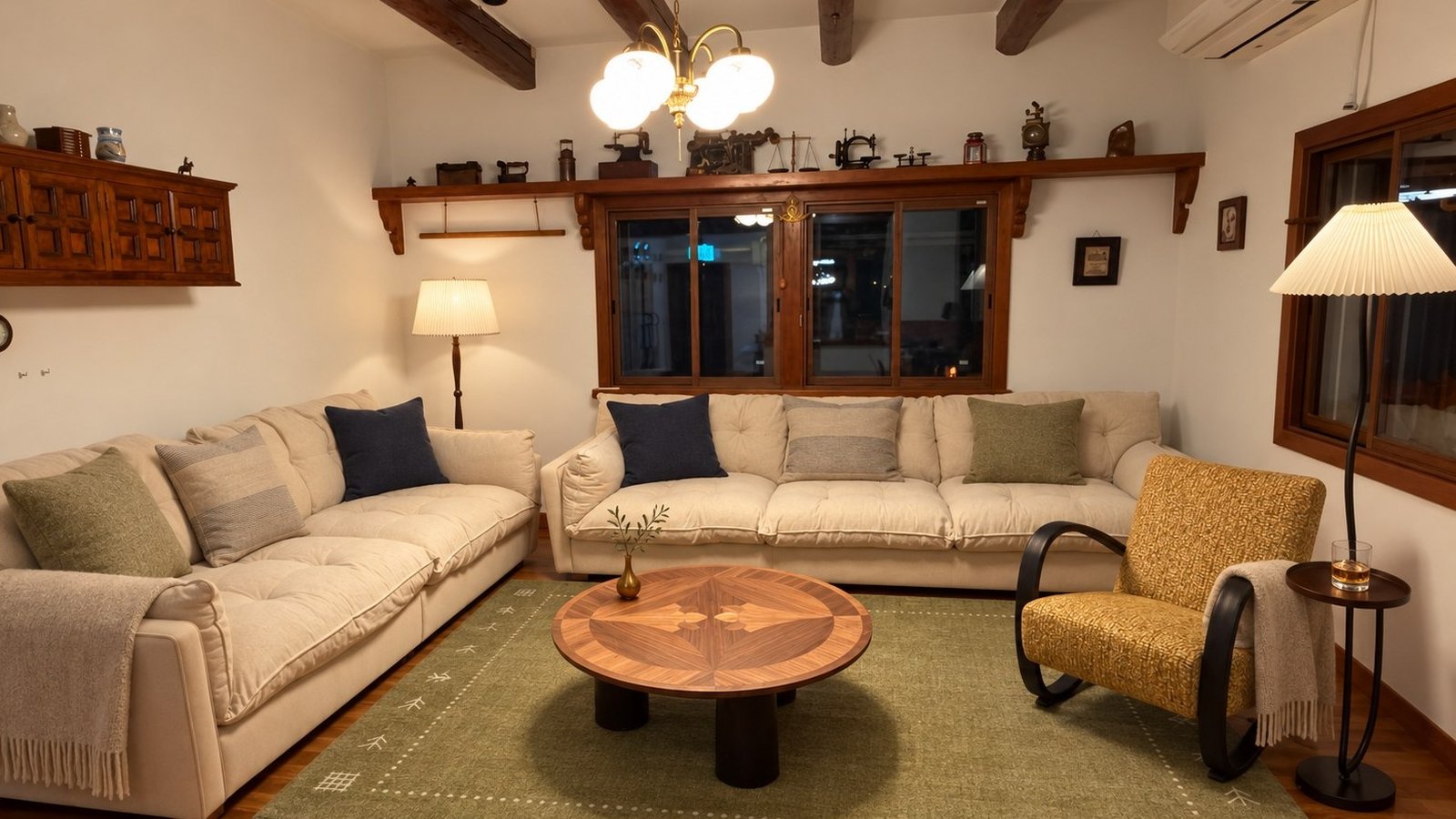
One example is Maykiss, a private chalet owned by Gemini株式会社, the company behind Hakuba Land; the photo at the top of this page shows its living room and comes from the company’s own photo library.
It is let to one group of up to 10 guests, with four suites, each with a private bathroom, 280 m² indoors and an outdoor sauna. It is in Misorano, a 5-minute walk, 400 m, to the entrance of the Echoland street.
It is self-catering with a fully equipped kitchen; breakfast is not included. Maykiss is not ski-in/ski-out, and there is no onsen. Opens on 1 December 2026 and is now accepting bookings. Maykiss sets out how a whole chalet compares with hotel rooms for groups of 6–10.
Before you book: what to check
- Meals and price unit: two meals or room only, and per person, per room or per house. JNTO notes ryokan rates are usually per person.
- Bathrooms: private or shared. JNTO notes shared bathrooms are common in minshuku.
- Bedding: in a minshuku you may be expected to put away your own futon.
- Whole building or room: cottages and rental holiday houses are not defined in the directory.
- Ryokan Business Act permit or minpaku notification: worth checking for any home-style listing. A notified minpaku has a notification number.
- Accommodation tax: since 1 June 2026, Hakuba’s tax has applied to guests staying at ryokan/hotel, simple lodging and minpaku homes in the village. Stays under ¥6,000 per person per night (room only, before consumption tax) are not taxed, and stays for school educational activities and similar purposes are exempt. Rates are in our Hakuba accommodation tax guide.
Sources
- Hakuba Village Tourism Bureau, lodging directory and search: https://www.vill.hakuba.nagano.jp/stay/ and https://www.vill.hakuba.nagano.jp/top/yado_kensaku/index.html
- JNTO, Minshuku and Guesthouses in Japan: https://www.japan.travel/en/guide/guesthouse-budget-accommodation/
- JNTO, Accommodation: https://www.japan.travel/en/in/accommodation/ and https://www.japan.travel/en/ca/plan/accommodation/
- JNTO, Japanese Ryokan Guide: https://www.japan.travel/en/guide/japanese-ryokan/
- Ryokan Business Act, Article 2 (e-Gov): https://laws.e-gov.go.jp/law/323AC0000000138
- Japan Tourism Agency, Ryokan Business Act overview: https://www.mlit.go.jp/kankocho/minpaku/overview/minpaku/law2.html
- Nagano Prefecture open data (Ryokan Business Act, 30 September 2026): https://www.pref.nagano.lg.jp/shokusei/kenko/shokuhin/seikatsu/documents/20260930hotel.csv
- Nagano Prefecture, minpaku notifications and rules: https://www.pref.nagano.lg.jp/shokusei/seikatsu/minpaku-tetsuzuki.html
- Maykiss (chalet and rates pages): https://maykiss.com/en/chalet and https://maykiss.com/en/rates
- Private Lodging Business Act (住宅宿泊事業法), Articles 2(3), 13 and 18 (e-Gov): https://laws.e-gov.go.jp/law/429AC0000000065
- Japan Tourism Agency, minpaku guidelines: https://www.mlit.go.jp/kankocho/minpaku/content/001622384.pdf
- Hakuba Village Accommodation Tax Ordinance: https://www.vill.hakuba.lg.jp/material/files/group/3/accommodation_tax_ordinance.pdf
- Nagano Prefecture open data page: https://www.pref.nagano.lg.jp/shokusei/kenko/shokuhin/seikatsu/opendata.html
- Hakuba Village, accommodation tax: https://www.vill.hakuba.lg.jp/gyosei/soshikikarasagasu/zeimuka/kazeigakari/2/syukuhakuzei/13525.html
Last checked: 19 November 2026.
Related guides
-
Hakuba Accommodation Tax: Rates per Night & Chalet Guide
Hakuba accommodation tax is ¥200–¥1,900 per person per night on room charges of ¥6,000+ before consumption tax. Chalet examples, exemptions and owner rules.
-
Hakuba Airbnb Rules: Minpaku Limits vs an Inn Licence
Hakuba minpaku is capped at 180 nights a year, and parts of Kamishiro and Hokujo are restricted 1 Dec–31 Mar, with exceptions. How an inn licence compares.
-
Hakuba with Kids 2026-27: Childcare, Lessons and Lift Passes
Hakuba with kids, 2026-27: which resorts run childcare and from what age, ski lessons for ages 3–6, kids' lift passes and what to check in a family stay.
-
Hakuba Ski Resorts: Hakuba Valley's 10 Resorts Compared (2026-27)
Which Hakuba ski resort suits you? Official data on all 10 Hakuba Valley resorts, picks for beginners, families, powder and park, and the 2026-27 lift pass.
-
Hakuba Ski Resort Parking 2026-27: Free Lots and Rules
Parking at Happo-One, Goryu and Iwatake from official pages: free lots, Happo's ¥1,000 gondola lots, overnight parking rules and Nagano's winter tyre rule.