
Hakuba Investment Property: What Listed Yields Really Mean
Category: Market & Investment
The yields on the two Hakuba investment property listings we checked are gross figures, not returns after running costs. Japan’s real estate advertising code defines a listed yield, for property bought to rent out, as one year’s expected rental income divided by the acquisition price, before taxes and upkeep costs. On 1 November 2026, these lodging listings showed 20.06% (based on an assumed 50% occupancy) and 9.51% (based on one ski season’s results).
Neither number tells you what is left after costs. Check the running costs, the monthly trading history and the permission that covers the planned operation. Land values are covered in our Hakuba land price guide, and overseas buyers can find the purchase steps in our guide for foreign buyers.
What does the yield on a Hakuba investment property listing mean?
The rule comes from the Fair Competition Code for real estate advertising. Its enforcement rules (Article 9, item 46) say a yield for a property bought and rented out must be used to mean “one year’s expected rental income as a share of the acquisition price”, and the ad must state three things:
- that it is one year’s expected rental income as a share of the acquisition price;
- that the expected income is not guaranteed;
- that the yield is before taxes and other costs needed to maintain the property.
The code is written for rent. Lodging revenue is not rent, yet Hakuba lodging listings use the same word, and the code gives no definition of a net yield at all. If a sales pack quotes a net yield, check who prepared it, the formula, the denominator and which costs it includes.
Here is what two listings showed when we checked them on 1 November 2026.
| Item | Listing A (LIFULL HOME’S investment portal) | Listing B (ARK NEXT resort listings) |
|---|---|---|
| Price | ¥48,000,000 | ¥50,000,000 (tax included) |
| Stated yield | 20.06% gross | 9.51% gross |
| Basis given | Assumed ¥53,500 per night × 50% occupancy = about ¥9.63M a year | Results for the Dec 2025 – Apr 2026 ski season |
| Building | Timber, built June 1961, 10LDK (remarks) | Timber, built November 2022, 2LDK, 68.2 m² |
| Licence as listed | “Inn-business licence obtained” (listing claim) | Not stated in the page text; tagged “minpaku / inn business possible” |
Sources: the two listing pages (toushi.homes.co.jp/bukkendetail/index/4731948/ and ark-next.com/bukken-detail/844), checked 1 November 2026. Licence claims are the listings’ own; we have not verified them.
Two details show why the basis matters. Listing A’s ¥9.63M matches ¥53,500 × 50% × 360 nights; over 365 nights the same inputs give ¥9,763,750. The page does not state how many nights a year it assumes.
The same page also prints a generic formula, “full-occupancy rent × 12 months ÷ price”, next to the 50% assumption in the remarks. Listing B’s 9.51% implies about ¥4.76M for five months, if it is that season’s revenue divided by the tax-inclusive price; the listing does not say what the other seven months earned.
How do you calculate gross and net yield for a Hakuba property?
Gross yield is annual income ÷ price. A common way to estimate net yield is (annual income − annual running costs) ÷ (price + purchase costs). The advertising-code rule above does not define net yield, so ask any seller or agent which costs they took out.
The example below is hypothetical. Every input is an assumption for illustration, not market data.
| Line | Assumption | Amount / yield (¥ / %) |
|---|---|---|
| Price + purchase costs | ¥50,000,000 + ¥3,500,000 | 53,500,000 |
| Annual revenue | Assumed | 6,000,000 (12.0% of the price: the “gross yield”) |
| Running costs at 40% / 50% of revenue | One operation-support firm’s estimate (below) | 2,400,000 / 3,000,000 |
| Net operating income (this example) | Revenue − running costs | 3,600,000 / 3,000,000 |
| Net yield on ¥53.5M | NOI ÷ total invested | 6.73% / 5.61% |
| If tax, insurance and repairs add ¥500,000 more | Assumed, where not inside the 40–50% | 5.79% / 4.67% |
Assumptions: our calculation. Excludes loan repayments, income tax, depreciation, furniture or renovation, and nights you use yourself.
The 40–50% range is one firm’s estimate, not an official figure.
VILLARY (COUNTOR Inc.), which offers holiday-rental operation support, wrote in an August 2026 article on Hakuba that fully outsourcing booking-site fees, cleaning, linen, consumables, utilities, snow clearing, pricing, reservations and guest handling takes “around 40–50%” of annual lodging sales, varying with property size, cleaning frequency, snowfall, equipment and the scope of the contract. Its list does not name property tax, insurance or repairs, so check whether your quotes include them.
How seasonal is Hakuba lodging demand?
Very. Hakuba Village’s estimates, prepared in 2024 to project accommodation-tax revenue, put 57.3% of the year’s overnight stays in December to March, and about 7 times as many stays in February as in November.
| Period | Estimated overnight stays | Share of year |
|---|---|---|
| December – March | 541,000 | 57.3% |
| April | 39,500 | 4.2% |
| May – October | 333,600 | 35.4% |
| November | 29,400 | 3.1% |
| Year | 943,500 | 100% |
Source: Hakuba Village, “白馬村制度の検討について” (8 October 2024), table 6.2. These are estimates built from 2019 mobile-phone location data, adjusted by ratios from ski-area and village tourism statistics; they are not counts of actual stays. Shares are our calculations.
The split is sharper for overseas guests: 91.5% of their estimated stays fall in December to March. These village-wide estimates do not predict any single property’s revenue, so check its monthly occupancy, achieved nightly rates and sales, especially outside winter. A flat 50% occupancy across the year is a modelling choice, so ask for monthly booking records rather than an annual average.
Can the property legally earn that income?
Check which notification or licence permits the projected operation. This guide compares a Private Lodging Business Act notification with an Inns and Hotels Act licence; they set very different limits on operating days.
A minpaku (private lodging) notification under the Private Lodging Business Act caps stays at 180 days a year, counted from noon on 1 April to noon on the next 1 April, with each noon-to-noon period as one day; the count stays with the house when the operator changes.
The cap counts days with guests, not the calendar nights in a formula. A model of 50% occupancy over 360 nights implies 180 nights with guests, the whole annual allowance; over 365 nights the model gives 182.5, a modelling result above the cap. Check which permission the projected nights rely on.
Nagano Prefecture also restricts minpaku in designated parts of Kamishiro and Hokujo in Hakuba from 1 December to 31 March. That restriction does not apply where the operator lives in the same building, on the same site or next door and stays present, or where a registered private-lodging manager is stationed the same way.
On the prefecture’s notification list dated 31 August 2026, we found no entries with a Hakuba Village address, while its inn-business open data of the same date lists 1,307 Hakuba entries. Both are entries on administrative lists as of 31 August 2026, not counts of businesses operating today.
An inn-business licence (旅館業許可) under the Inns and Hotels Act has no annual night cap. The licence belongs to the operator, not the building. For a buyer to succeed to the existing operator’s status through a business transfer, seller and buyer must get the governor’s approval (Article 3-2), and Nagano says this must happen before the transfer contract takes effect; after that, a new licence is needed.
Gemini株式会社 succeeded to the operator’s status for the simple-lodging business 500 MILES HAKUBA through this procedure, with the Omachi health office’s approval (長野県大町保健所指令8大保第12-16号). The full comparison is in Hakuba Airbnb rules: minpaku vs an inn licence.
A Tokyo District Court case (29 March 2022, summarised by a lawyer for the Osaka Prefecture Real Estate Transaction Specialist Center, 大阪府宅地建物取引士センター) shows why this matters. In that case the seller was a licensed real estate business, and the court held that when it explained the projected yield and the income behind it, it also had to investigate and explain legal restrictions that could affect that income.
The court also reduced the damages by 40% for the buyer’s own negligence: the buyer, a company in the rental business, relied on the stated 7.44% gross yield when setting the price and signing the contract. That case was about a ten-storey building in Tokyo and a sign ordinance, not lodging.
Which costs come off a Hakuba yield?
Some costs have official rates; most need quotes for the actual building.
| Cost | Official figure | Where to get your number |
|---|---|---|
| Fixed asset tax (固定資産税) | 1.4% of the taxable value, based on the village’s assessed value (固定資産税評価額), not the price. Converting a house to an inn or simple lodging can end the residential-land reduction (Local Tax Act Art. 349-3-2) and raise the land tax. | Seller’s latest tax notice; see Hakuba property tax |
| Hakuba accommodation tax | Paid by guests: ¥200–1,900 per person per night where the room-only, tax-exclusive charge is ¥6,000 or more (1 June 2026 – 31 May 2029, incl. ¥100 prefectural tax); the operator collects it and files monthly | Hakuba accommodation tax guide |
| Water and public sewer | Hakuba Village tariffs (13 mm meter basic charge ¥1,837 a month for water) | Yearly running costs of a Hakuba house |
| Septic tank (where installed) | No official figure | Contractor and statutory-inspection quotes |
| Operation, cleaning, booking fees, snow, heating | No official figure | Quotes; seller’s last 12 months of invoices |
| Insurance and repairs | No official figure | Insurer quotes; building inspection |
Sources: Hakuba Village fixed asset tax, accommodation tax and water tariff pages; Local Tax Act Art. 350(1); Septic Tank Act Arts. 10–11 (checked 31 October 2026).
Guests are the taxpayers for the accommodation tax; the operator collects and pays it to the village. Account separately for its effect on guest pricing and on monthly paperwork. Since June 2026 each facility files and pays, in principle, by the end of the following month. Those returns are one way to cross-check a seller’s claimed stays, although stays priced under ¥6,000 per person are not taxed and do not show up in the tax amount.
Documents to check before making an offer on a Hakuba investment property
When Hakuba Land reads an investment listing, we check both the arithmetic and the assumptions behind it. Ask for:
- The basis: assumed or actual, which months, nightly rate per house or per person, occupancy, and how many nights a year.
- Twelve months of booking-platform reports and the accommodation-tax returns filed since June 2026.
- The licence type, number and holder, and the timing for approval of the business transfer.
- Building facts that match: Listing A gives 37.2 m² in its data table and about 371 m² in its remarks. Check the registry, the building confirmation and the fire-safety compliance notice.
- A year of utility, snow and cleaning invoices, and whether the management contract can transfer to you.
- Your own use: every night you stay is a night not sold.
When a house is converted into an inn or simple lodging, building confirmation is required where the total floor area changing use exceeds 200 m²; at 200 m² or less that procedure is not needed, but the building rules must still be met.
Where Hakuba Land fits
Gemini株式会社, the licensed real estate broker behind the Hakuba Land brand, helps buyers compare a listing’s stated yield with its licence, monthly revenue and running costs before an offer; our partner listings show the transaction type. Where a building needs work, our long-term partner builders carry out the construction and we coordinate. Management for outside owners is in preparation and not yet available.
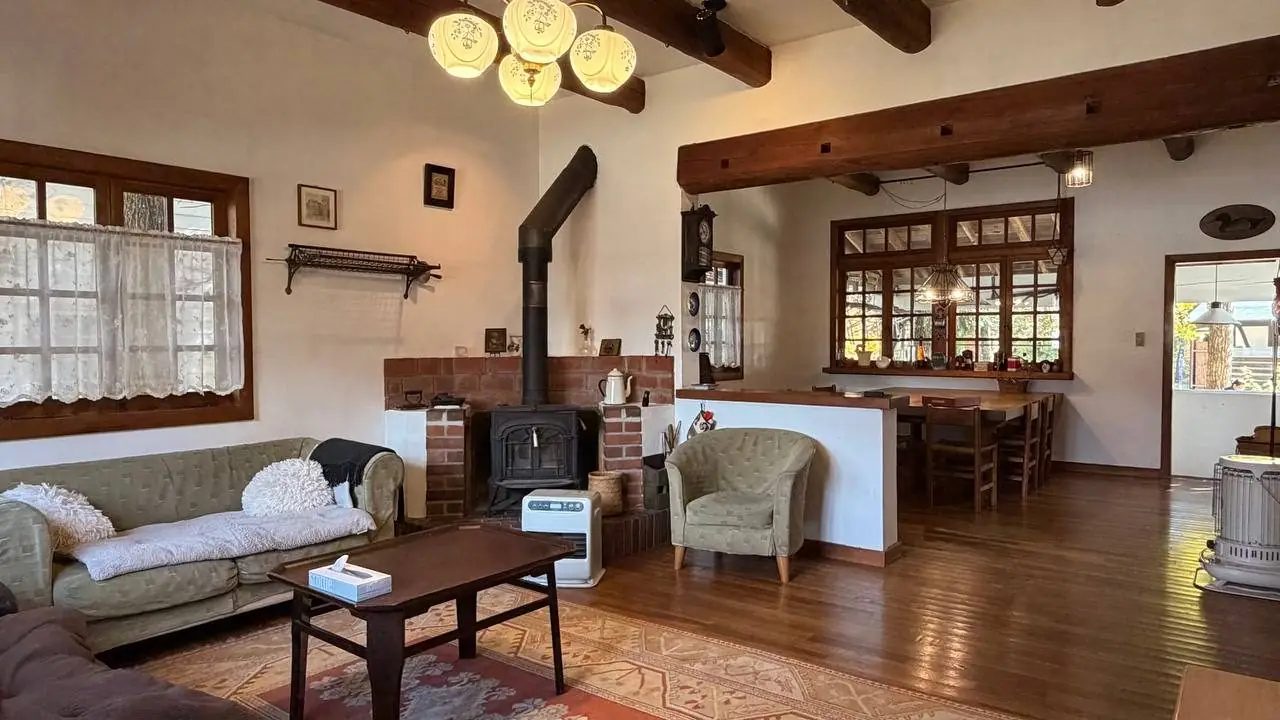
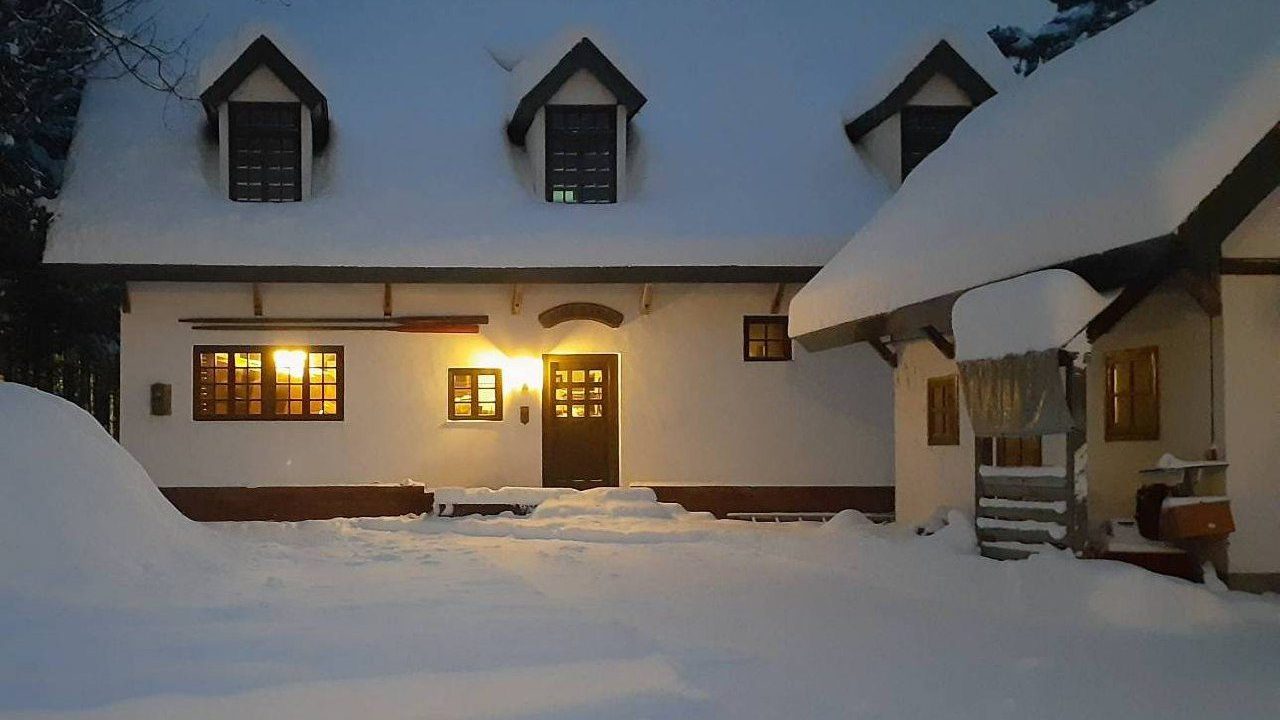
Disclosure: Gemini株式会社 owns Maykiss (pictured) and 500 MILES HAKUBA.
How we checked: listing figures were read on the listing pages on 1 November 2026; rules and rates were checked against the real estate advertising code (2025 edition), Hakuba Village’s tax documents, Nagano Prefecture’s minpaku and inn-business pages and the e-Gov texts of the Private Lodging Business Act and Inns and Hotels Act. This is general information, not investment, tax or legal advice; confirm with a professional before you buy.
Frequently asked questions
What if the property has less than 12 months of trading history?
Ask for every record that exists, note which months were closed or used by the owner, and treat any month without records as an assumption in your own calculation, not as a result.
Related guides
-
Hakuba Airbnb Rules: Minpaku Limits vs an Inn Licence
Hakuba minpaku is capped at 180 nights a year, and parts of Kamishiro and Hokujo are restricted 1 Dec–31 Mar, with exceptions. How an inn licence compares.
-
Buying a House in Hakuba: Yearly Running Costs and Checks
Buying a house or chalet in Hakuba? See the yearly running costs from official tariffs, the winter work an absent owner must arrange, and what to check first.
-
Japan Property Tax for Foreigners: A Hakuba Owner's Guide
Hakuba property tax is 1.4% of the taxable base, not the price. Assessed values, why legal holiday homes miss land relief, and tax agents abroad.
-
Hakuba Accommodation Tax: Rates per Night & Chalet Guide
Hakuba accommodation tax is ¥200–¥1,900 per person per night on room charges of ¥6,000+ before consumption tax. Chalet examples, exemptions and owner rules.
-
Hakuba Land Prices 2026: Official Data and How to Read It
Hakuba property prices in 2026: official MLIT land price and land survey figures for Hakuba points, what MLIT says drives them, and what to check before buying land.