
Three Bungalows for Sale in Moriue, Hakuba: 49.67 m² Each (HL-0010)
Category: Market & Investment
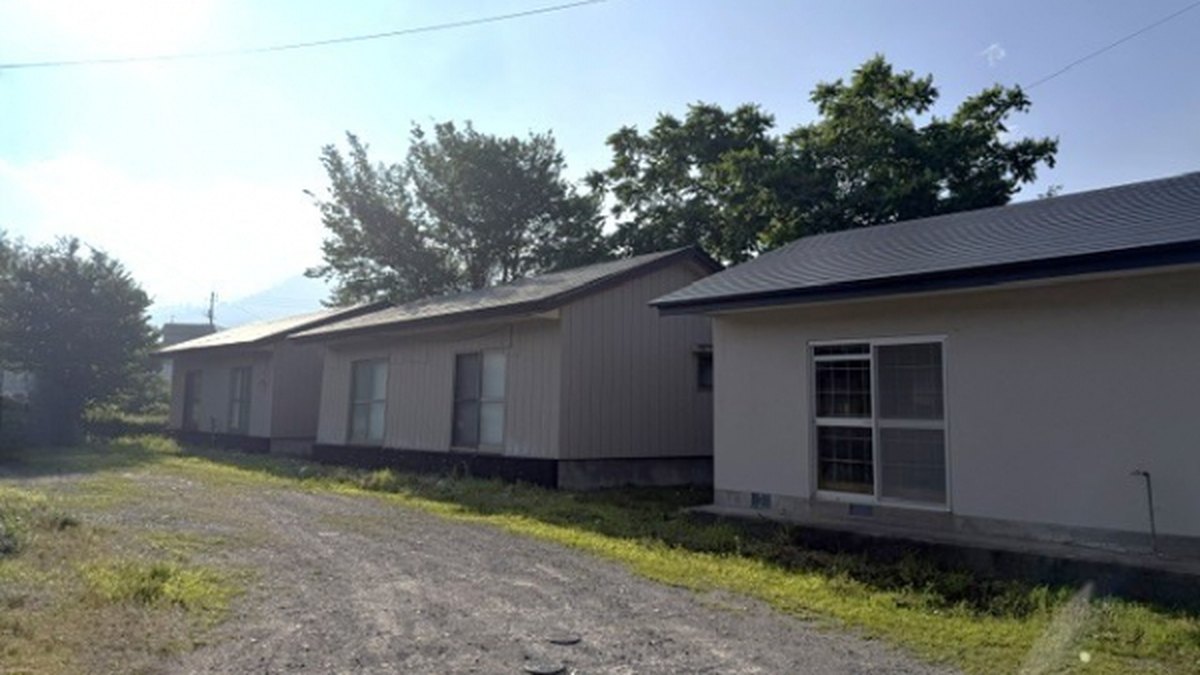
HL-0010 is three single-storey buildings in Moriue, Hokujo, Hakuba Village, sold together for ¥47,500,000. Each has 49.67 m² of building area, 149.01 m² in all, on 550.57 m² of freehold land. They were completed in March 1971 and are vacant.
The photos show a gravel lane with the three pale-sided buildings in a row and tall trees behind. Each unit has a concrete-block storage shed, and white oil tanks stand against the walls. Shinano-Moriue Station on the JR Oito Line is a 7-minute walk. The listing’s highlight is plain: ideal as rental housing or staff dormitory. This article sets out what the listing says and what to check before you offer.
See the full listing with photos → HL-0010
HL-0010 at a glance
Listing details as checked on 1 November 2026.
| Item | Listing details |
|---|---|
| Price | ¥47,500,000 (all three buildings) |
| Property type | Used lodging |
| Buildings / units | 3 single-storey buildings, 3 units |
| Layout | 3K (kitchen, three 6-tatami Japanese-style rooms) |
| Building area | 49.67 m² each, 149.01 m² in total |
| Structure | Concrete block, steel-sheet roof, single storey (per the property summary sheet; the listing page’s basic-info table says timber) |
| Land | 550.57 m², freehold; registered as residential land (takuchi) |
| Completed | March 1971 |
| Planning | Non-delineated area, no use zone; building coverage 60%, floor area ratio 200% |
| Road | South: 3 m-wide public road; frontage 4 m on the listing page, about 32 m on the summary sheet; no private road share |
| Parking | 3 spaces (1 per unit) |
| Utilities | Electricity, propane, public sewer; the summary sheet also lists mains water and an oil tank |
| Access | JR Oito Line, Shinano-Moriue Station, 7 min walk |
| Status | Vacant; immediate handover |
| Transaction type | Brokerage |
At the asking price that works out to about ¥15.83 million per building (land included), ¥319,000 per m² of building area and ¥86,000 per m² of land. This is simple division, not a valuation.
Three bungalows, 49.67 m² each
The listing describes the three buildings together as 3K: a kitchen and three 6-tatami Japanese-style rooms. Each building has 49.67 m² of floor area and all three are the same size. It does not say building by building where the kitchen, rooms, bath and toilet are, so check at the viewing or ask the seller for floor plans.
Listed fittings are an indoor washing-machine space, light fittings, flush toilets and hot water in the kitchen. The main windows face south. Renovation is listed as none, and the remarks say the interiors need renovation.
The structure is recorded two ways. The summary sheet says concrete block with a steel-sheet roof; the listing page’s basic-info table says timber. The sheds in the photos are block-built, while the houses appear to have panel siding. Go by the land registry and the building itself. It will shape how, and at what cost, you renovate.
All three are single-storey, so their footprint is roughly their floor area. As a rough estimate they cover about 27% of the land, under the 60% limit; use a survey for exact figures.
Use: rental, staff housing or lodging
The listing suggests rental housing or a staff dormitory. Three separate buildings, each with its own parking space and shed, suit separate lets. The property type is used lodging, but the listing does not say whether an inn-business licence exists, its number or its holder, and we do not add to it.
- Renting out: leases fall under the Act on Land and Building Leases. With an ordinary lease, a landlord needs justifiable grounds to refuse renewal (Art. 28). A fixed-term lease must be made in writing, with a separate written explanation beforehand that it will not be renewed (Art. 38) (Act on Land and Building Leases, e-Gov).
- Staff housing: if a company leases the buildings for its staff, agree the contract type first and ask the local fire department what fire equipment is required.
- Paid accommodation: under the Inns and Hotels Act, running paid lodging needs a prefectural licence (Art. 3), and taking over an existing operator’s position needs the governor’s approval (Art. 3-2) (Inns and Hotels Act, e-Gov). Ask the seller about past use and talk to Hakuba Village and the Omachi public health centre. For the two routes compared, see Minpaku vs ryokan licence in Hakuba.
The listing gives no rent, occupancy or revenue figures, and neither do we.
A 1971 building: seismic check first, then renovation
March 1971 is before Japan’s June 1981 seismic standard. MLIT says many buildings built before 1981 to the older standard lack adequate earthquake resistance, and recommends a seismic assessment first, then retrofit or rebuilding depending on the result (MLIT: seismic upgrading of housing and buildings).
Renovation also has a legal step. Under the Air Pollution Control Act, the contractor must survey for asbestos-containing materials before altering or repairing a building. For renovation contracts of ¥1 million or more including tax, the result must also be reported to the prefecture (Ministry of the Environment: asbestos survey reporting). Renovating three buildings at once will probably reach that amount. We suggest:
- an architect to confirm the structure, run a seismic assessment and check roofs, walls and foundations;
- renovation quotes that include the asbestos survey, its cost and timing;
- checking for building-confirmation records and whether registered areas match the listing;
- budgeting for new fittings and inspecting the oil tanks and gas equipment in all three.
Land and road: the 3 m lane to the south
The land is 550.57 m², registered as residential land (takuchi), meaning land registered for building. It sits in a non-delineated area with no use zone; no National Land Use Planning Act notification is needed, and there is no private road share.
The public road to the south is 3 m wide. Inside a city planning area, the Building Standards Act requires a building plot to touch a road for at least 2 m (Art. 43). If a road under 4 m wide is designated under Art. 42(2), the road boundary is usually treated as 2 m from the centre line, and that strip cannot be built on when you rebuild (Building Standards Act, e-Gov). Before signing, ask the seller for a survey and check with the village or prefectural building authority how the road is classed, whether setback applies, and whether the frontage is 4 m or about 32 m.
Running costs and the market
- Yearly costs: property tax, sewer charges, propane, heating oil and snow clearing, for three buildings. See Buying a villa in Hakuba: running costs and winter care.
- Property tax: ask the seller for the latest tax notices for the land and all three buildings. See Hakuba property tax.
- Accommodation tax: if used for lodging, Hakuba Village has levied an accommodation tax since 1 June 2026 (Hakuba Village).
- Purchase costs: on top of the price, allow for registration, stamp duty, the pro-rated property tax and the brokerage fee.
In MLIT’s 2026 official land prices, Hakuba Village residential land rose +22.8% on average (MLIT: 2026 land prices, Hakuba Village). These are benchmark values for specific survey points and cannot be compared directly with this asking price.
Checklist before you offer
- Structure: concrete block or timber, by registry and inspection; seismic assessment.
- Renovation: plan of each building, bath and kitchen condition, asbestos survey, quotes.
- Use: rental, staff housing or lodging, and the matching contract, fire and licence checks (seller, Hakuba Village, Omachi public health centre).
- Road: Art. 42(2) status, setback and frontage (survey).
- Utilities: mains water and sewer connections, oil tanks and gas equipment.
- Overseas buyers: see Can foreigners buy property in Hakuba?
About this listing
Hakuba Land is a brand of Gemini株式会社, a licensed real estate brokerage, which handles this property as broker. The listing was published on 31 July 2026 and its next scheduled update is 13 November 2026. This article is general information, not legal or tax advice.
Last checked: 1 November 2026.
Sources
- Act on Land and Building Leases, Arts. 28 and 38 (e-Gov, Japanese)
- Inns and Hotels Act, Arts. 3 and 3-2 (e-Gov, Japanese)
- MLIT: seismic upgrading of housing and buildings (Japanese)
- Ministry of the Environment: asbestos survey reporting (Japanese)
- Building Standards Act, Arts. 42 and 43 (e-Gov, Japanese)
- Hakuba Village: accommodation tax (Japanese)
- MLIT: 2026 official land prices, Hakuba Village (Japanese)
Frequently asked questions
How much is HL-0010 and what do you get?
The asking price is ¥47,500,000 for all three buildings together. You get three single-storey buildings completed in March 1971 (49.67 m² each, 149.01 m² in total) on 550.57 m² of freehold land registered as residential land (takuchi, land registered for building). The listing shows 3 units, one parking space per unit and a storage shed for each unit.
What is it suited to?
The listing's own highlight is 'ideal as rental housing or staff dormitory', and the property type is used lodging. It does not say whether an inn-business licence exists, its number or its holder. To run paid accommodation you would need a new licence or the governor's approval to take over a business, so check with the seller, Hakuba Village and the Omachi public health centre before signing.
What should I check on a 1971 building?
It predates Japan's June 1981 seismic standard. MLIT says many buildings built to the older standard lack adequate earthquake resistance and recommends a seismic assessment first. The listing says the interiors need renovation, and before renovation work the contractor must survey for asbestos.
When is handover?
The buildings are vacant and the listing says handover is immediate.
Related guides
-
Buying a House in Hakuba: Yearly Running Costs and Checks
Buying a house or chalet in Hakuba? See the yearly running costs from official tariffs, the winter work an absent owner must arrange, and what to check first.
-
Hakuba Airbnb Rules: Minpaku Limits vs an Inn Licence
Hakuba minpaku is capped at 180 nights a year, and parts of Kamishiro and Hokujo are restricted 1 Dec–31 Mar, with exceptions. How an inn licence compares.
-
Japan Property Tax for Foreigners: A Hakuba Owner's Guide
Hakuba property tax is 1.4% of the taxable base, not the price. Assessed values, why legal holiday homes miss land relief, and tax agents abroad.
-
Buying Land in Hakuba: What You Can Build and What to Check
Looking at Hakuba land for sale? Zoning, landscape and development rules, villa-area agreements, road access and what to check before you buy.
-
Can Foreigners Buy Property in Hakuba? 2026 Buyer Guide
Can foreigners buy property in Hakuba? Yes. Here is the 2026 process, costs, the new non-resident reporting rule, land price data and Hakuba-specific checks.